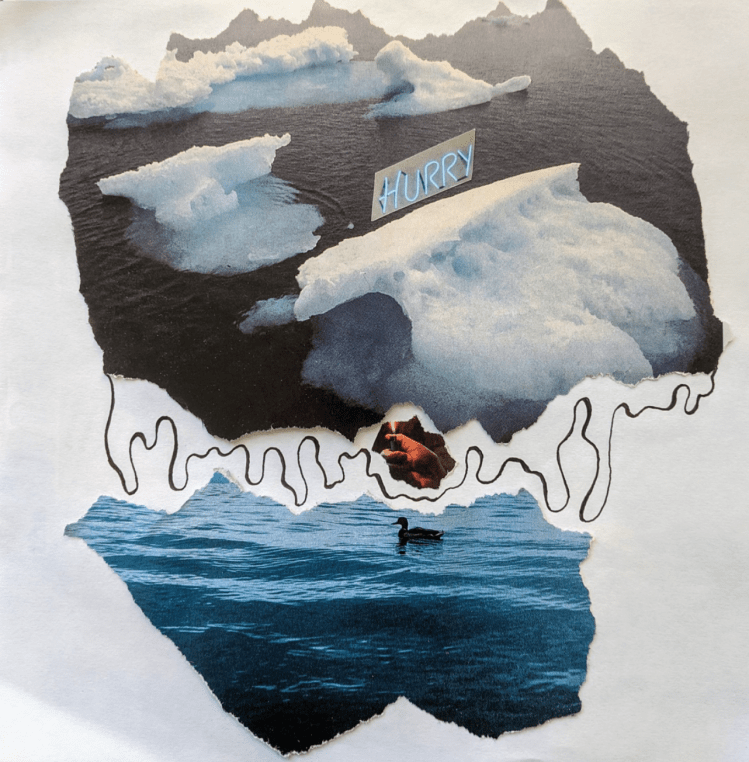
I have spent the last 20 years in higher education teaching art, sustainability, and creative activism. In working with undergraduate students, my interests lie at the intersections of sustainability and mental health, looking specifically at eco-anxiety and eco-grief, and how the arts can serve the healing of personal and collective trauma. My years of facilitation and teaching experience in the realm of higher-education, along side an artist’s sensitivity and depth of insight, come to bear in my work with groups. The image to the right is a student collage about the melting polar ice caps, from my course ‘Art as Therapeutic Process.’
On anima mundi–
Carl Jung’s concept of anima mundi – the soul of the world – very much informs my philosophy as an artist involved in the healing arts. When working with groups, I make explicit how we personalize and carry the larger wounds of the world, bringing “maior autem animae pars extra corpus est” to the surface. This old alchemical adage translates to “the greater part of the soul lies outside the body.” In my own experience with traditional mental-health counseling, I have found one-on-one talk therapy to be very helpful. Equally as beneficial to my healing and growth has been my participation in group processes that have provided certain therapeutic value (but are not necessarily “therapy” in a conventional sense): grief rituals, collaborative artmaking, and ecstatic dance are among the many. These circles and spaces have enabled me to experience “the greater part of my soul outside of my own body,” which unto itself brings about nourishing experiences of wider connection, witnessing, and compassion.
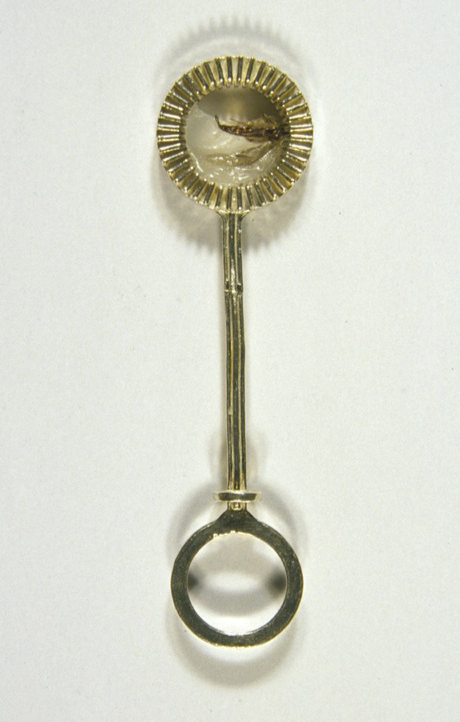
The image on the left is from my series Containing Lightness. Silver bubble wand, found insect, tealight candle.
We are enveloped in a field of consciousness; everything possesses soul. This was known to every indigenous culture. What we feel from the surrounding world is not necessarily a projection of our own minds outward into the environment. We can travel just about anywhere in the world and we will inevitably come across vestiges of clear-cuts, those bleeding and scarred lands that look so desolate and violated. These places announce themselves as a wound, a rupture where life once moved and breathed…Western psychology would most likely suggest that the grief we are feeling is related to our own experience of being diminished as a child, a metaphoric clear-cut, as it were. What if, however, the feelings we have when we pass through these zones of destruction are actually arising from the land itself?…What if we are not separate from the world at all? What if this is the anima mundi, the soul of the world, weeping through us?
Francis Weller, The Wild Edge of Sorrow
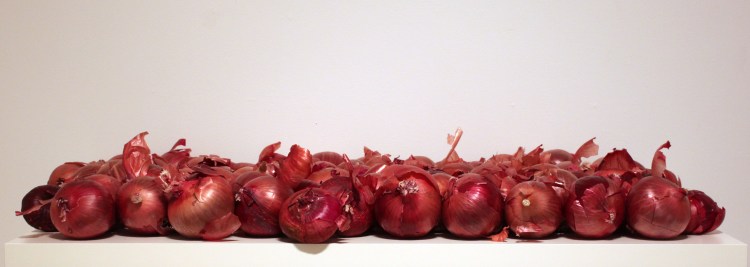
In this art installation, a table of onions lay waiting, their skins moving from the air of a hidden fan. The sound of rushing water quietly accompanies. Titled Threshold, the onion becomes a perfect metaphor for the soul of the world weeping through us, as many of us have experienced the tears that burn our eyes and fall down our cheeks when we cut into an onion. This piece was inspired by a haiku I wrote:
………………… sorrow breathes into / tight spaces that lie waiting / river tumbles on ……..
On trauma–
Trauma frequently emerges when working with grief, ritual, and creative expression. I appreciate Francis Weller’s characterization of trauma as “rough initiations”–intense events (losses, illnesses, etc.) that do not possess a community container. He contrasts this with sacred processes of containment in rites of initiation held in the village structures of yore. I am inspired by examples of how veterans in the U.S., suffering with post-traumatic stress disorder, find treatment and relief in traditional indigenous ceremonial sweat lodges, which include chanting, singing, prayer, ritual, and the sharing of stories. I also deeply appreciate the incorporation of alchemic processes and metaphors when it comes to navigating grief and trauma.
In alchemy, these seasonal migrations were called times in the Nigredo, or the Blackening. This is helpful to see that this as an inevitable and necessary time, a time of shedding and letting go, of sitting close to the furnace of death as it cooks away all that is spent and no longer serving life. Our time in the Nigredo is a period of dissolution. Old patterns and perceptions, old, outworn identities begin to dissolve as we are unmade. Things fall apart…. The Nigredo was called the “subtle dissolver” in alchemy and was viewed as a necessary element in the great work of creating the philosopher’s stone…Our sojourn in the darkness, while difficult and painful, is also a time of alteration and change. The process of change, however, is not one of addition and growth, but rather one of letting go, decay, subtraction and death, what the alchemists called putrifactio.
Francis Weller, “Baptized By Dark Waters”
I very much see my work as a guide, since in the Nigredo we are, as Weller says, “without fixed stars, known destinations, familiar markers or guideposts.” In grief-tending and ritual work, I also facilitate building the community container in such a way so that we are all guides for one another. Ram Dass’ famous quote “we are all walking each other home” wonderfully captures the essence of my orientation towards my work.
On how I spend my days–
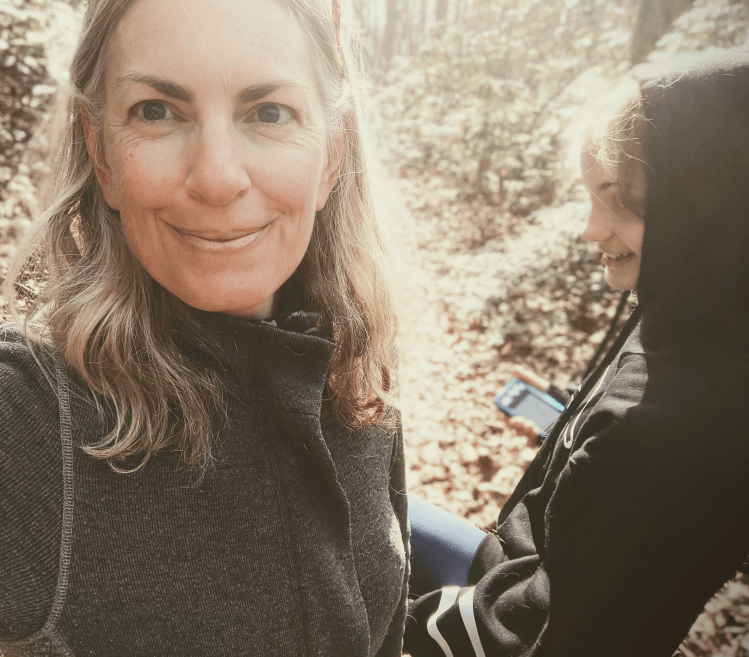
I currently live with my daughter and our pack of four-legged companions in the Piedmont region of North Carolina, the occupied lands of the Keyauwee and Saura Peoples. When I am not teaching and leading retreats, I maintain a small private coaching / consulting practice and spend time connecting with my Celtic and Sicilian ancestral roots. I love to garden, hike, camp, improvise dinner recipes, go on slow walks with my elderly Siberian Husky, and facilitate my adventurous daughter’s varied passions, from scuba diving to aerial silks.
 Samantha DiRosa